


THE TMMi MATURITY MODEL


ORGANIZATION
What is TMMi Foundation

MATURITY MODEL
What is the TMMi® Testing Process Maturity Model?

ADVANTAGES
The advantages of applying the TMMi® maturity model in companies

PATH
The TMMi professional path
WHAT IS THE
TMMi®TMMi®
FOUNDATION
The TMMi Foundation is a non-profit organization based in England that supports companies around the world in improving software and systems testing and achieving higher, more sustainable levels of product quality.
Thanks to TMMi, software development organizations can evaluate and improve their testing processes and obtain formal certification of their testing process maturity.
The TMMi Foundation brings together independent experts from around the world who have produced:
A freely available maturity model for software quality and testing called the Test Maturity Model Integration (TMMi® Model). This model has been recognized as the world's leading model for test process improvement.
Competence certifications called TMMi Professional and TMMi Test Process Improver, which certify understanding of the model and provide visibility to leading practitioners in the field of test process improvement. TMMi Professional training is delivered by globally recognized training institutions.
A training program to become a TMMi-accredited Assessor and/or Lead Assessor.
A licensed TMMi Assessment Method (TAM), usable by TMMi-accredited Assessors and Lead Assessors, to enable formal and informal assessments in companies.
A framework to enable organizations to develop their own assessment method; the TMMi Assessment Method Application Requirements (TAMAR) describe all the details a TMMi assessment method must meet to achieve accreditation.
Local representation of the TMMi Foundation is ensured through TMMi local chapters. ITA-STQB is the TMMi Local Chapter for Italy.
THE
TMMi®
MODELMODEL
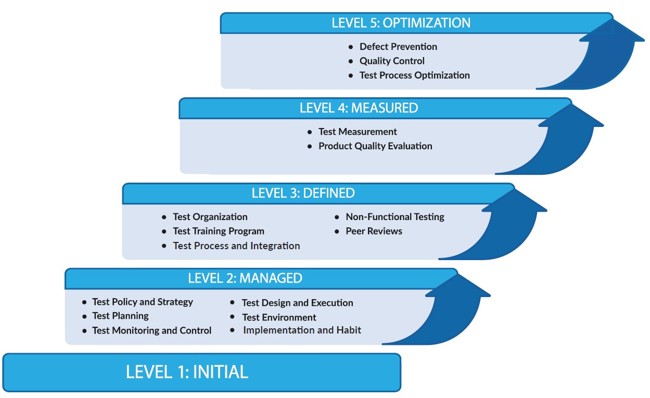
The TMMi model is based on industry best practices, and during its development, numerous approaches to testing and software quality were evaluated and considered, combining the positive elements to ensure a broadly applicable test improvement model.
The TMMi model analyzes the software testing process at different maturity levels, assuming that all organizations begin at Level 1 on the TMMi maturity scale. The greater the maturity of an organization's testing practices, the higher the TMMi maturity level achieved.
The model presents a phased architecture for test process improvement, defining the stages an organization passes through as its testing process evolves from an ad hoc, unmanaged approach to one that is managed, defined, measured, and in optimization mode.
Achieving each stage ensures that the foundation for appropriate improvement has been laid, which forms the basis for the next stage.
Test process improvement efforts focus on the organization's needs within the context of its business environment.
The scope of application for each of the different maturity levels is as follows:
Level 2 – Managed
At this level, the fundamental approach to testing is defined and managed, and can vary from project to project (or team to team) within an organization, with particular attention to testing policy and strategy. This level provides guidance for planning, monitoring, and control, as well as test design techniques, with each project/team having control over test execution. At Level 2, dedicated test environments exist for projects/teams, and institutionalization is addressed by the Implementation and Consolidation process area.
Level 3 – Defined
At this level, all projects/teams follow the same standards and procedures across the organization or organizational unit. Level 2 practices are still in place, testing training programs exist, and testing is integrated into the development lifecycle and across all projects/teams from the earliest stages. Non-functional testing is planned and executed across all projects and teams, and reviews are used across each project or team.
Level 4 – Measured
Measurement of activities and results is applied thoroughly from the early stages of development to ensure products are as defect-free as possible. Measurements cover both the testing process and product quality.
Level 5 – Optimization
At this level, all activities and results are evaluated, and optimization activities are implemented to ensure continuous improvement in defect prevention and quality optimization.
ADVANTAGESADVANTAGES
OF THE TMMi®
MODEL
Today, TMMi is used in many industries, with various lifecycle approaches, and is considered the world's leading model for improving testing processes.
Using TMMi, it is possible to identify risks, strengths, and best testing practices. Furthermore, the TMMi Foundation has created an assessment framework to support TMMi-based assessments. With a TMMi assessment, an organization can identify its strengths, weaknesses (risks), and best testing practices. This will provide the organization with a detailed understanding of its testing maturity level.
Using TMMi will improve the effectiveness and efficiency of testing. Case studies and surveys of TMMi users have demonstrated clear benefits of using the TMMi model. The TMMi Global User Survey report states that 88% of TMMi users experience benefits in terms of product effectiveness/quality, such as reduced risk, and 77% experience benefits in terms of testing efficiency, such as increased test productivity.
A testing process improvement program can be implemented using TMMi. By measuring (intermediate) results derived from evaluations, TMMi provides detailed guidance for improvements.
TMMi's staged representation allows for clear prioritization of process areas for improvement. Moving through the different maturity levels increases the ability of test management and software quality to align with business needs. Benefits include, among others, improved software product quality with fewer defects, as well as increased testing efficiency.
TMMi is also rich in testing practices, examples, and tips, thus supporting the implementation of proposed improvements.
A comprehensive accreditation system is available for Assessment Service Providers, Assessors, and Lead Assessors. Assessment Service Providers (ASPs) can formally assess an organization. If an organization complies with the TMMi model criteria, it will subsequently be certified by the TMMi Foundation and listed on the TMMi website.
TMMi has an independent and detailed model for test process improvement. This model complements the CMMi model, largely following the same maturity structure in terms of phase representation, but also providing significantly more detail and support for software and system testing.
As part of its goal to become and remain the world's leading model for test process improvement, the TMMi Foundation maintains close collaboration with the ISO/IEC organization throughout the development and maintenance of the TMMi model. Since 2014, the TMMi Foundation has supported ISO/IEC Working Group 26 (within JTC1/SC7 Software and Systems Engineering) as a Category C contact. The TMMi Foundation has allocated resources to contribute to this specific working group with the following objectives:
Align the TMMi process reference model with the concepts and definitions provided by ISO 29119
Provide input and feedback on all draft standards under development by Working Group 26
Serve as technical experts within Working Group 26 to contribute to the development of software testing standards
Provide feedback from the TMMi community on the future direction of development of international software testing standards.
THE
TMMi®
PATHPATH
The TMMi Foundation has established a global assessment and certification system for testing organizations, through TMMi-accredited Assessors and Assessment Service Providers, as well as an international certification system for industry professionals, with training offered by TMMi-recognized providers.
The following certifications are available for testing professionals:
The TMMi Professional certification, which demonstrates competence in the following areas:
Applying the TMMi model
Providing support in interpreting and understanding the TMMi model
Guiding and advising an organization or project when using the TMMi model as a basis for test process improvement
The TMMi Test Process Improver certification, which demonstrates competence in the following areas:
Initiating and managing a test improvement project and successfully implementing TMMi in an organization or project
Providing effective support for TMMi-based improvement and generating business value for sponsors and stakeholders
The TMMi Test Process Improver certification allows you to be included in the public registry of certified TMMi Test Process Improvers available on the TMMi website and use the TMMi Test Process Improver logo.
TMMi Professionals can become:
TMMi Accredited Assessors, demonstrating expertise in the following areas:
Conduct informal TMMi assessments that highlight an organization's strengths and weaknesses
Provide TMMi-based recommendations for testing improvement
Serve as a co-assessor in a formal assessment
TMMi Accredited Lead Assessors, demonstrating expertise in the following areas:
Conduct formal TMMi assessments, which form the basis for an official assessment and can lead to the organization achieving certification at a given TMMi level
Determine how the organization's testing processes compare to TMMi best practices and identify areas for improvement
Provide TMMi-based recommendations for testing improvement.
In both cases, you will be added to the public registry of accredited TMMi Assessors available on the TMMi website and may use the TMMi Assessor logo.
Companies can become Accredited Training Providers, i.e., training providers for TMMi, or Assessment Service Providers, i.e., organizations formally approved by the TMMi Foundation as accredited assessment service providers. These organizations operate not only locally but also globally, providing their services worldwide.